
- Major ActivitiesMajor ActivitiesThe Northeast Asian History
Foundation is the center of
Northeast Asian history research - ResourcesResourcesThe Northeast Asian History
Foundation is the center of
Northeast Asian history research - NewsNewsThe Northeast Asian History
Foundation is the center of
Northeast Asian history research - IntroductionIntroductionThe Northeast Asian History
Foundation is the center of
Northeast Asian history research
-
Screen size
-

- Major Activities
- Resources
- News
- Introduction
- Website Guide
Resources
Publication
- Date 2015.03.24
- Hit 1503
1. All rights reserved by the Northeast Asian History Foundation
2. No part of the files on this website may be reproduced and/or copied in any way, shape, or form without permission.
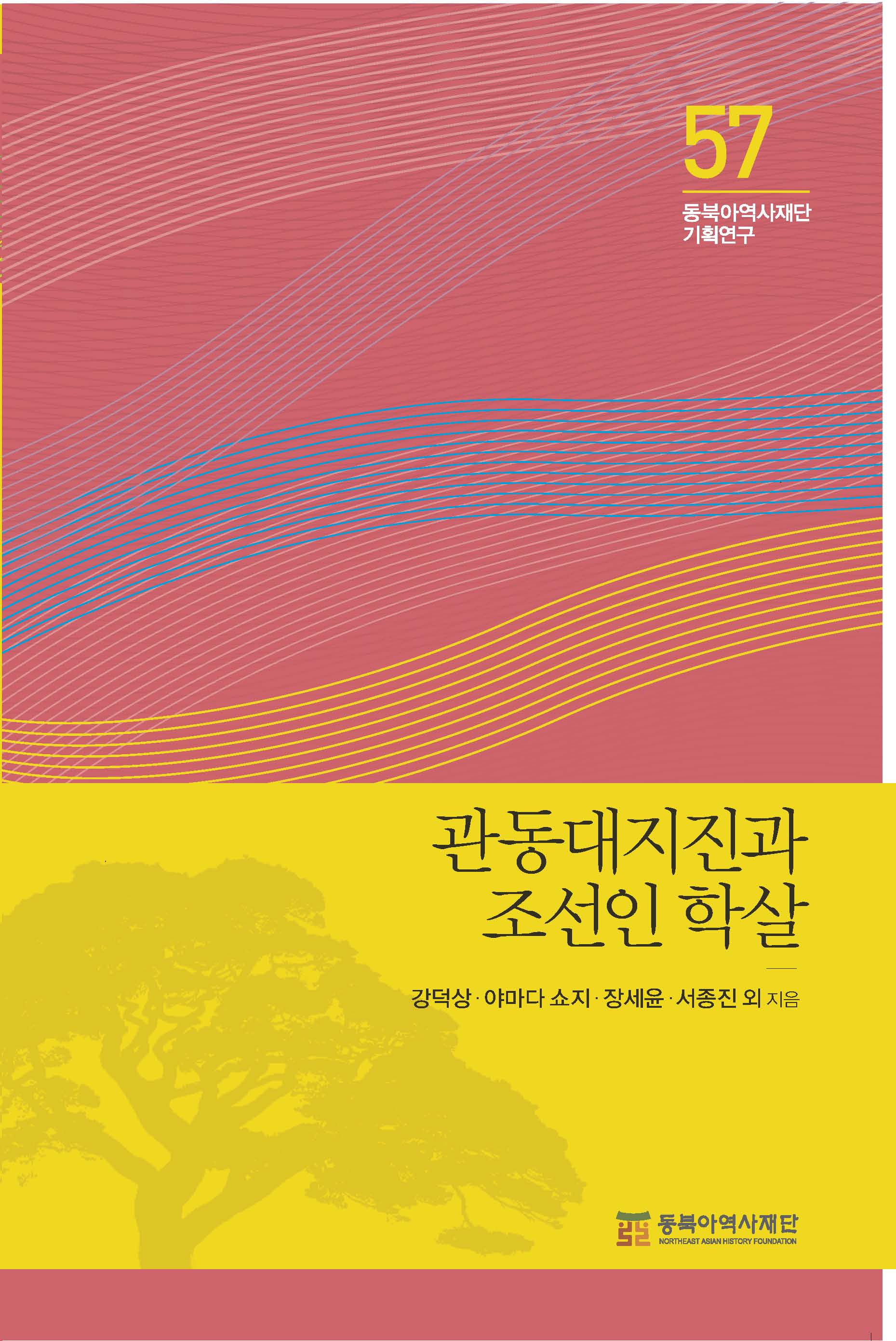
Title: The Great Kanto Earthquake and the Korean Massacre
By KANG Deok-sang, YAMADA Shoji, CHANG Se-yun, SEO Chong-chin, et. al.
Northeast Asian History Foundation | 225*152mm (A5 New) | 320 pages | KRW 11,000 | December 31, 2013
ISBN 978-89-6187-317-8 93910
Contents
Preface 11
Part 1| Korea-Japan Relations and the Historical Significance of the Great Kanto Earthquake
● Korea-Japan Relations in terms of the Great Kanto Earthquake _KANG Deok-sang 19
● How should the Japanese public understand the historical significance of the massacre of Koreans in the wake of the Great Kanto Earthquake, and cope with the political and ideological situation their nation is in today? _ YAMADA Shoji
Ⅰ. Introduction: The Author’s Critical View of the Massacre of Koreans following the Great Kanto Earthquake 45
Ⅱ. The Inception of the Japan and Korean Solidarity for Korea’s Liberation the Night before the Great Kanto Earthquake 46
Ⅲ. The Japanese Police’s Great Suppression of the Tokyo May Day demonstration in May 1923 under a Slogan Supportive of the Liberation of Colonies 50
Ⅳ. The Massacre of Koreans in the Wake of the Great Kanto Earthquake 52
1. Rumors About the Riot of Koreans Spread by the Authorities and their Remarks Approving of the Massacre of Koreans 52
2. The Mobilization of Troops and the Declaration of Martial Law 56
3. How a Vigilante Corps Was Organized and its Ideology 57
Ⅴ. A Series of Schemes to Cover up the Japanese Government’s Responsibility for the Massacre of Koreans 64
1. Schemes to Fabricate a Riot by Koreans 64
2. Hiding the Bodies of Slaughtered Koreans 68
3. Covering up the Japanese Police’s Responsibility by Compiling a Book on the History of the Great Kanto Earthquake 69
Ⅵ. Changes from the mid 1990s onward in the Perception of Japan’s Aggression and Colonial Rule of Asia 70
1. Policies by the Yokohama City Education Committee and the Tokyo Metropolis Education Committee to Distort Historical Facts about the Massacre of Koreans in the Wake of the Great Kanto Earthquake 70
2. The Rise of the Liberalistic View of History 71
3. The Rise of the LDP’s Extreme Rightist Shinzo Abe [安倍晋三] and the Trend of Distorting the Perception of Japan’s Aggression and Colonial Rule of Asia 74
Ⅶ. Conclusion 80
Part 2| Research and Education about the Great Kanto Earthquake
● A Study on the Massacred Koreans and Perpetrators at the Time of the Great Kanto Earthquake _ KANG Hyo-sook
Ⅰ. Introduction 85
Ⅱ. The Number of Koreans Killed 91
Ⅲ. The Japanese Government’s Treatment of the Perpetrators 112
Ⅳ. Conclusion 125
● History Education in Postwar Japan and the Massacre of Koreans in the Wake of the Great Kanto Earthquake _ TANAKA Masataka
Ⅰ. Introduction 129
Ⅱ. Analysis of History Textbooks 130
Ⅲ.Postwar History Education and the Massacre of Koreans in the Wake of the Great Kanto Earthquake 133
Ⅳ. Conclusion 136
● Analysis of the Descriptions of the Great Kanto Earthquake and the Massacre in Japanese Textbooks _ SEO Jong-jin
Ⅰ. Introduction 153
Ⅱ. The Japanese Conservatives’ Attack on Textbooks 155
Ⅲ. The Japanese Media’s Coverage of the Descriptions of the Great Kanto Earthquake in Textbooks and Auxiliary Textbooks 158
Ⅳ. Analysis of the Descriptions of the Great Kanto Earthquake and the Massacre in Primary, Middle, and High School Textbooks, and their Contents 161
1. The Total Number of People Killed or Missing 166
2. The Number of ‘Korean’ Victims 167
3. Perpetrators of the Massacre 168
4. Groundless Rumors 169
5. Figures 170
Ⅴ. Conclusion 172
● The Korean Japanese and the Great Kanto Earthquake Massacre of Koreans in Korea’s History Education _KIM In-deok
Ⅰ. Introduction 179
Ⅱ. Trend in Korea of Describing the History of the Korean Japanese 182
1. The Recent History of the Korean Japanese 182
2. Overview of Descriptions of the History of the Korean Japanese 186
3. Descriptions of the Massacre of Koreans in the Wake of the 1923 Great Kanto Earthquake 189
Ⅲ. Descriptions of the Massacre of Koreans in the Wake of the Great Kanto Earthquake 192
1. The 1923 Great Kanto Earthquake Massacre of Koreans 193
2. Groundless Rumors 194
3. Social Movement in Japan and the Security Situation 195
4. Emperor System Ideology and the Massacre of Koreans 196
5. Japanese Media 198
6. The Death of over 6,000 Koreans 199
7. Japanese Socialists 200
8. The Massacre of Koreans and Afterward 201
9. The Meaning of the Massacre of Koreans in the Wake of the 1923 Great Kanto Earthquake 202
Ⅳ. Conclusion 203
Part 3| The Great Kanto Earthquake and Remaining Challenges
● The Independent’s Report and the Recent Trend of Research on the Massacre of Koreans in the Wake of the Great Kanto Earthquake _ CHANG Se-yun
Ⅰ. Introduction: The Necessity of Identifying the Current Situation for Revealing the Truth 207
Ⅱ. Reports by Dongnip Sinmun on the Massacre of Koreans in the Wake of the Great Kanto Earthquake 212
1. Overview of Dongnip Sinmun 212
2. Brief Overview of the Reports on the Massacre of Koreans 214
Ⅲ. Overview of The Dong-A Ilbo and The Chosun Ilbo Reports 225
Ⅳ. Academic Research and Description in Korea of the Massacre of Koreans in the Wake of the Great Kanto Earthquake 229
1. Research Trends in the Korean Academia 229
2. Descriptions In the Recent High School Textbooks of the Massacre of Koreans in the Wake of the Great Kanto Earthquake 231
Ⅴ. Descriptions related to the Great Kanto Earthquake in North Korea Academia 234
Ⅵ. Trends in the Japanese and the American Academia 236
1. Trends in the Japanese Academia 236
2. Trends in the American Academia 239
Ⅶ. Trends in Related Academic Conferences in 2013 241
Ⅷ. Conclusion: Challenges and Prospects 243
● 1923 to 2013: Have We Overcome State and Nation Nine Decades After the Great Kanto Earthquake? _ MORIKAWA Humito
The Significance of the Japan Federation of Bar Associations’ Recommendations and the Japanese Government’s Responsibility for its Policy to Fractionalize the Peopl
Ⅰ. Raising the Question: Is Chauvinism Regaining Power? 249
Ⅱ. Situations surrounding Class in Japan and Asia in the 1920s when the Great Kanto Earthquake Occurred 250
Ⅲ. State Responsibility for the Massacre at the Time of the Great Kanto Earthquake: The Significance of Recommendations by the Japan Federation of Bar Associations 252
Ⅳ. The Essence of Government Responsibility: ‘Withdrawal’ of Class Conflict through Nationalism 253
Ⅴ. What are the Japanese ‘Responsible’ for? 255
Ⅵ. Can We Overcome State and Nation? 255
Ⅶ. The Situation of 2013: Continued Economic Crisis and Mass Struggles Around the World 257
Ⅷ. Neo-liberalism as the Common Enemy of the Public and Working Class: Privatization, Outsourcing, Temporary Employment 258
Ⅸ. Exhaustively Calling for the State to Take Responsibility Represents the International Solidity of the People (Class) 260
● Civic Movements in Korea to Reveal Truths About the Massacre of Koreans in the Wake of the Great Kanto Earthquake _ KIM Jong-su
Ⅰ. The Beginning of Activities to Reveal the Truth about the Kanto Massacre of Koreans 263
1. Akigaya Taeko, a Witness Encountered at a Summer Camp 264
2. The Kanto Panel Exhibition at the Koryo Museum in Shinjuku, Tokyo 265
3. The Kanto Massacre of Koreans Case Brought to the National Assembly of Korea 266
Ⅱ. Solidarity Organization Launched in Tokyo to Reveal Truths about the Kanto Massacre of Koreans and Regain Honor 268
Ⅲ. Korea-Japan Civic Solidarity Project to Reveal the Truth and Regain Honor 278
1. Photographic Sources Exhibition and Academic Symposium 278
2. Tour to Study the Site of the Massacre 285
3. Legislation Movement Demanding a State-led Investigation into the Truth 294
4. Memorial Project to Regain the Honor of the Victims 300
5. Project to Find the Bereaved Families of the Massacre Victims 301
Ⅳ. Assessment of and Challenges for Civic Movements in Korea to Reveal the Truth 304
1. Assessment of Civic Movements to Reveal the Truth 304
2. Future Projects and Challenges of Civic Movements to Reveal the Truth 305
Index 307
